What a Turnkey Mechanical Contractor Actually Means for a Commercial Schedule
In house sheet metal fabrication and a turnkey scope change what a facility manager can actually schedule around. Here's what that looks like on a real commercial job.
August 26, 2026 · 4 min read
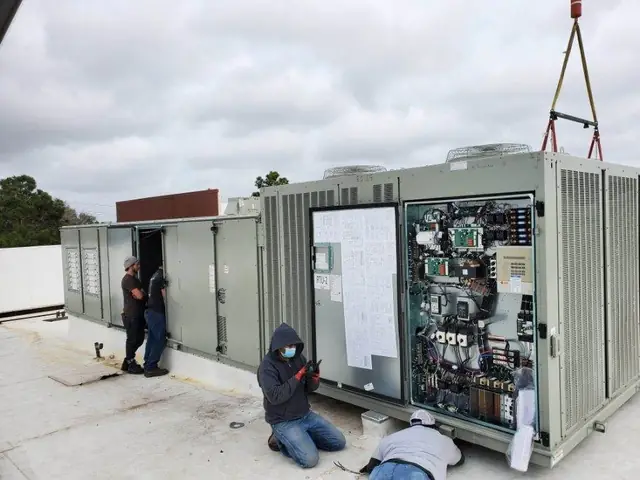
Facility managers hear the phrase "turnkey mechanical contractor" often enough that it can start to sound like a generic pitch. It isn't, when a contractor actually operates that way, and the practical difference shows up most clearly in scheduling, not in the sales conversation.
What turnkey means beyond the label
A turnkey mechanical contractor handles design, planning, manufacturing, installation, and commissioning as one continuous scope rather than a chain of separate vendors. Optimal Air Solutions works across DX units, high capacity chillers, VRF systems, kitchen ventilation, precision-controlled wine units, refrigerant, chillwater and process piping, and Building Automation Systems covering sensors, high-efficiency thermostats, and smart zoning. That range matters because a facility rarely needs just one of those things in isolation, it needs them coordinated on one timeline with one team accountable for how the pieces fit together.
Why in house fabrication is the part that actually changes a schedule
The detail that has the biggest real effect on a project calendar is easy to overlook: Optimal Air Solutions fabricates its own sheet metal and ductwork in house, alongside its own spray foam insulation and coatings work, an approach the company describes as "2 Companies In 1." On a typical commercial project, ductwork fabrication is a separate vendor with its own lead time, its own queue, and its own chance to slip. When fabrication happens in house instead, that dependency disappears from the critical path. Custom duct runs, transitions, and fittings can be built to the exact dimensions the job needs without waiting on an outside shop's schedule, which is often the difference between a project that holds its completion date and one that doesn't.
For a facility manager coordinating a rooftop unit swap, a kitchen ventilation retrofit, or a full mechanical build-out around an occupied building, that single change removes one of the most common sources of delay on a commercial mechanical scope.
What this has looked like on real projects
Optimal Air Solutions has done commercial mechanical work for Target, Kroger locations, Wells Fargo, the Houston Zoo, the Texas Parks and Wildlife Sea Center, and Terminal B at George Bush Intercontinental Airport. Two of those projects give a real sense of scale: the Target installation involved 120 tons of cooling, and the Grand Oaks Church project involved 150 tons of cooling. Those aren't small residential-scale jobs, they're the kind of high tonnage, high complexity work that requires coordinating design, fabrication, and commissioning across a building that in most cases can't simply shut down while the work happens.
What to ask a mechanical contractor before a commercial project
- Ask whether ductwork and sheet metal fabrication happens in house or through a separate vendor, and how that affects lead time
- Ask who is accountable for commissioning once equipment is installed, not just for getting it delivered and set in place
- Ask about experience with your specific building type, whether that's retail, restaurant kitchen ventilation, a medical facility, or a government building
The sectors this covers
Optimal Air Solutions serves commercial, medical, governmental, and industrial sectors across Houston and all surrounding contiguous counties, and works on high tonnage and specialized systems including chillers, VRF technology, and precision piping alongside standard commercial AC repair and rooftop unit service.
Smart zoning and automation change the operating picture too
Turnkey scope doesn't stop once equipment is running. Optimal Air Solutions installs Building Automation Systems covering sensors, high-efficiency thermostats, and smart zoning, which gives a facility manager ongoing control over how a building is conditioned rather than a fixed setup that only a technician can adjust. For a multi-zone retail space, a church sanctuary that fills and empties on a schedule, or a building with mixed office and warehouse space, that kind of zoning control is often what actually determines whether a mechanical system performs well day to day, long after the installation crew has left the site.
The company's own stated priorities on commercial work
Optimal Air Solutions lists six specific priorities on its commercial services pages: integrity, operating as a turnkey mechanical contractor, personal customer service, quality, solid relationships, and being an industry leader. For a facility manager, the ones worth pressure-testing directly are personal customer service and solid relationships, since those are the two that actually get proven out over a multi-phase project rather than in a single sales meeting. A contractor that fabricates its own ductwork and self-performs commissioning has fewer places for a relationship to break down between subcontractors, which is where a lot of commercial projects actually lose time.
Emergency coverage matters on the commercial side just as much as scheduling a new build-out. Optimal Air Solutions offers repair coverage 24 hours a day, seven days a week, which is relevant for any facility manager responsible for a building that can't simply go without cooling or heating overnight, whether that's a kitchen with refrigeration on the line, a medical facility, or a retail space that opens early.
For a facility manager evaluating a mechanical contractor for an upcoming project, the fabrication capability and the project history are both worth asking about directly rather than assuming from the pitch. Reach the commercial team at (832) 779-1008 to talk through scope and scheduling for your building.
Optimal Air Solutions — (832) 779-1008
Call (832) 779-1008More articles
Why the Biggest AC Isn't the Best AC for Your Houston Home
An air conditioner that's too big for your house can leave rooms cold and the air clammy at the same time. Here's why size matters more than horsepower.
What SEER Actually Buys You When You're Comparing AC Systems
The SEER rating on a new system is more than a sticker number. Here's what it measures and how to weigh it against what each tier actually costs.